One Vintage Coloring Page Is Easy. Keeping 30 Pages in the Same Decade Is Where AI Usually Starts to Break.
Ask an AI image generator for a “1950s kitchen coloring page” and you can get something attractive in seconds.
The harder part begins when you try to turn that one image into an entire book.
The telephone belongs to the wrong decade. The hairstyle changes. The furniture suddenly looks modern. Page 18 is dramatically more detailed than Page 3. The cover promises nostalgia while the interior feels like generic AI line art.
And if the book is intended for older colorists, there is another problem: AI often adds exactly the tiny textures, shadows and visual clutter that make a coloring page harder to use.
That is the problem 336 Agentic Prompts for Memory Lane Coloring Book Series is attempting to solve: not simply generate vintage pictures, but give the AI a complete book assignment with an era, audience, page sequence and publishing workflow.

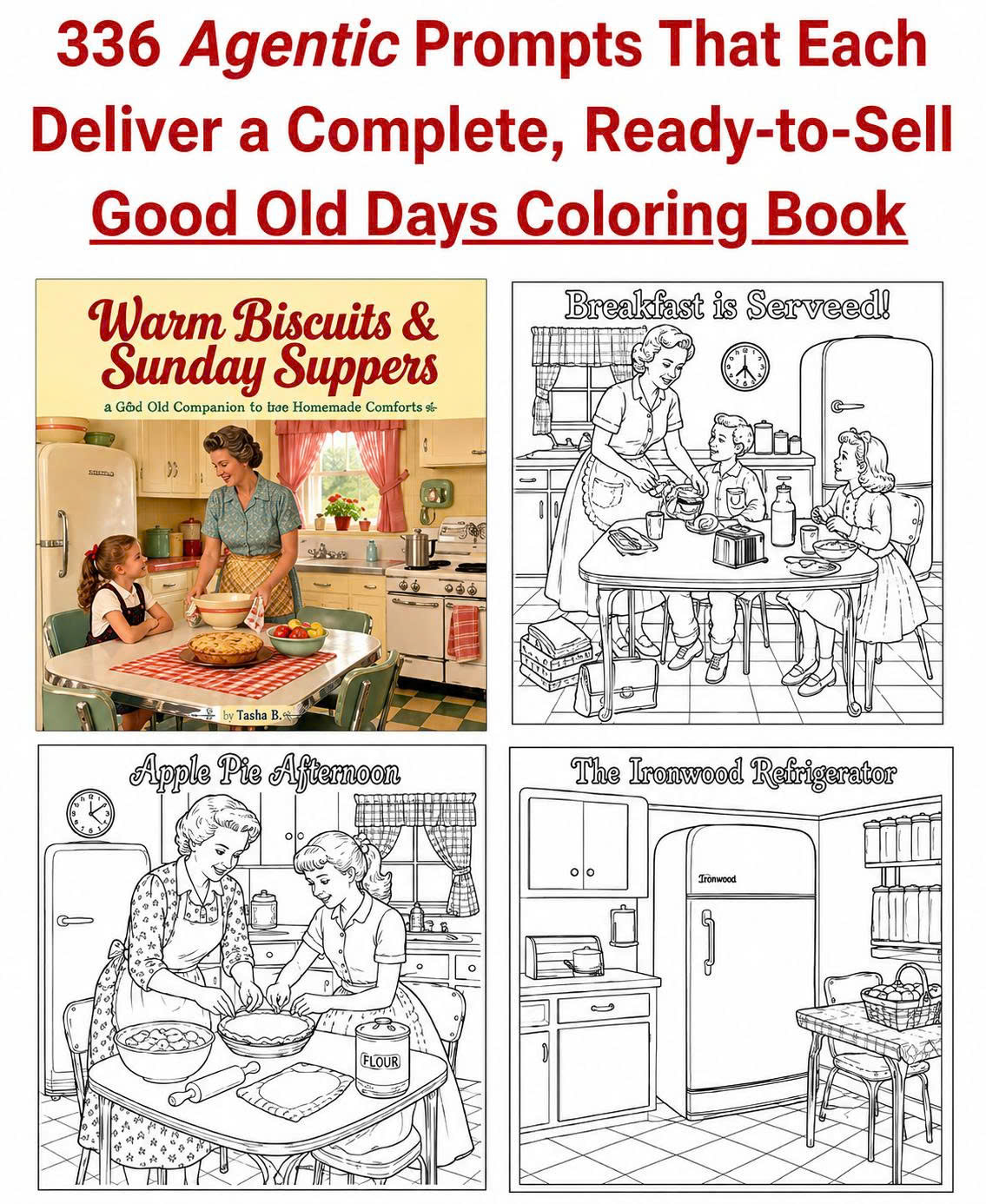
336 Agentic Prompts for Memory Lane Coloring Book Series.
The First Image Is Not the Hard Part. The Other 29 Pages Are.
AI makes isolated artwork easy.
Publishing exposes the weaknesses that isolated demos hide.
Historical Drift
A scene may look convincingly “retro” while quietly including appliances, telephones, fashion or household details from the wrong decade.
The 30 Pages Do Not Feel Like One Book
Characters, scene density, line weight and illustration style can change as the AI continues generating.
AI Loves Too Much Detail
Shadows, textures, tiny background objects and decorative clutter can make an image look impressive on-screen but unpleasant to color.
Random Nostalgia Is Not a Series
A diner, a kitchen, a classroom and a county fair may all be nostalgic, but without a clear framework they can feel like unrelated products.
The Artwork Is Only Part of the Product
You still need the title, description, keywords, cover direction, front matter, file organization and final quality control.
Fixing Problems Late Is Expensive
Discovering that the concept is repetitive after producing 30 images is much more frustrating than correcting the book plan before rendering begins.
The goal is to create 30 coloring pages that feel as though they belong to the same memory, the same period and the same book.
336 Prompts — But the Important Number May Be 48
The product contains 336 Agentic Prompts organized around 48 nostalgia themes.
Those themes include familiar mid-century American memory triggers such as:
grandmother's kitchen, Main Street, soda fountains, station-wagon road trips, drive-in movies, school classrooms, church gatherings, family television nights, five-and-dime stores and county fairs.
That gives the prompts something more useful than “vintage.”
It gives each project a recognizable memory world.
The prompts are designed to do more than request one picture.
A project can first ask the AI to prepare:
- an original book title;
- a subtitle;
- marketplace description;
- back-cover copy;
- seven keyword phrases;
- historical-period rules;
- a structured 30-page scene sequence;
- 30 interior image prompts;
- a front-cover prompt;
- a matching back-cover prompt;
- front-matter content.
Then you can inspect the plan before committing to the complete production run.
What One Prompt Is Designed to Do
Choose a Memory World
Start with a specific nostalgia environment instead of a vague “vintage coloring book.”
Build the Full Book Plan First
The AI creates the title, copy, keywords, period rules, cover direction and 30-page interior sequence.
Review Before Rendering
Check the scene list and change weak or repetitive ideas before production begins.
Carry the Era Rules Into Each Page
The historical boundaries are designed to travel with the individual image instructions.
Generate the Artwork
Move through the interior scenes using the controlled line-art and period instructions.
Review and Organize the Assets
Check the generated artwork, cover, publishing files and supporting materials before commercial use.
Period Accuracy Lock Addresses a Real Weakness in AI Nostalgia Artwork
“Vintage” is an aesthetic.
A specific historical period is a constraint.
Those are not the same thing.
An AI image may look beautifully retro and still contain objects that do not belong together historically.
The system addresses that problem with what the vendor calls Period Accuracy Lock.
For example, a project placed between 1955 and 1959 can specify period-appropriate:
- architecture;
- appliances;
- furniture;
- cookware;
- clothing;
- hairstyles;
- telephones;
- household objects.
The prompt can also prohibit obviously later technology and contemporary design details.
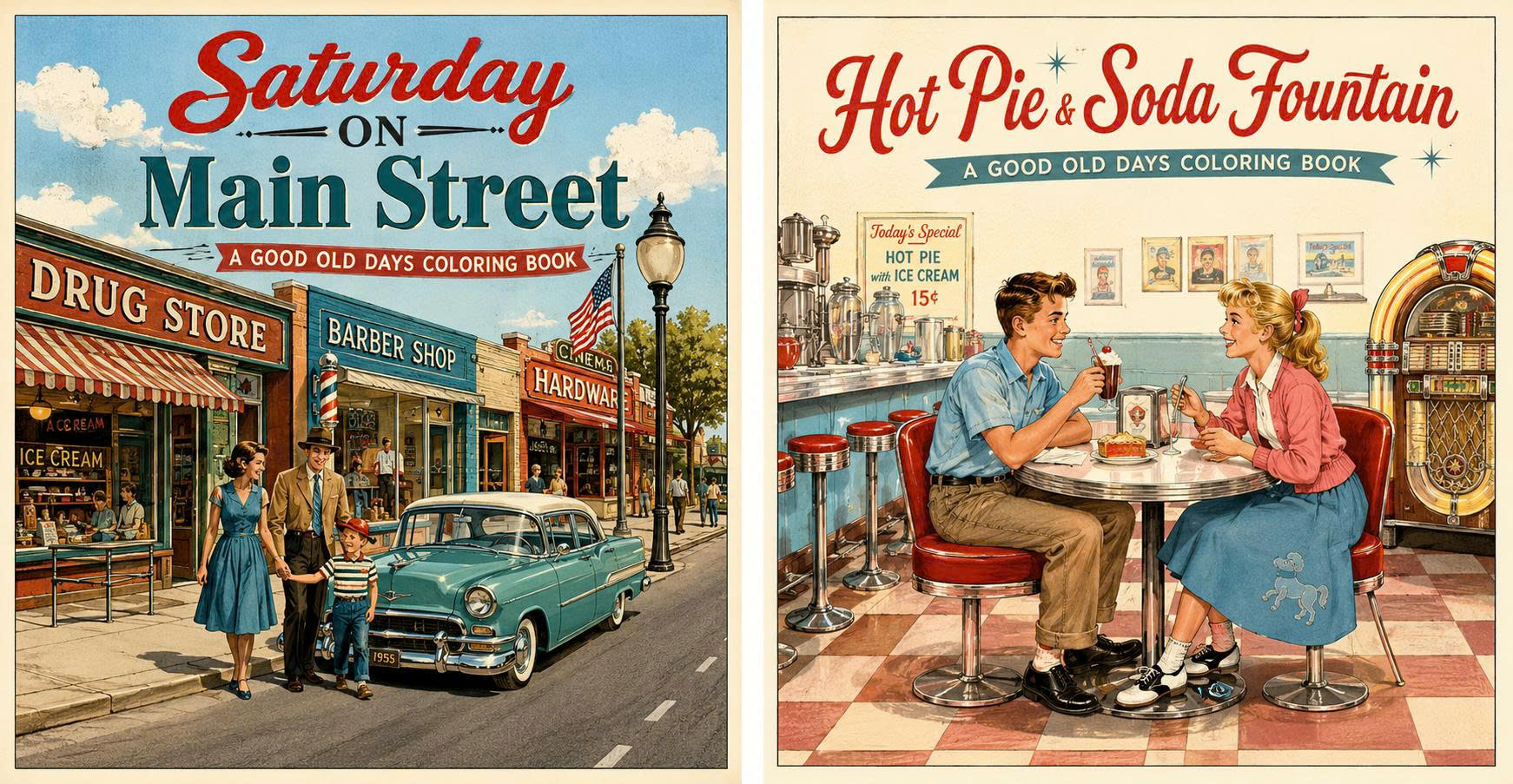
Example of the nostalgia coloring-book direction this workflow is intended to produce.
The Prettiest AI Image Is Not Always the Best Coloring Page
This is another detail I think the product gets right conceptually.
Generative models tend to add detail because detail often makes an image look richer on a screen.
But a coloring page has a different job.
The interior instructions are designed around:
Pure Black Outlines
Cleaner line art instead of painterly grayscale rendering.
Pure White Backgrounds
Keeps the finished page closer to practical coloring-book artwork.
Bold-to-Medium Contours
A more readable visual structure for the intended older audience.
Moderate Visual Density
Enough detail to feel interesting without filling every inch of the page.
Clearly Separated Objects
Reduces visual confusion between neighboring elements.
Larger Enclosed Areas
Provides more practical spaces for actual coloring.
The prompts also attempt to restrict:
grayscale, shading, crosshatching, dense micro-patterns and unnecessary visual clutter.
What Makes This More Useful Than a Folder of 336 Image Prompts
Prompt quantity is easy to advertise.
What I care about more is how many production decisions the system removes from the creator.
Here the more useful sequence is:
choose the memory world → lock the historical period → plan all 30 pages → review the structure → generate the artwork → prepare the publishing assets.
That is a much stronger reason to consider the product than the raw prompt count alone.
What Can One Agentic Project Produce?
Title + Subtitle + Product Description
The project begins with more than the interior artwork.
Back-Cover Copy + Seven Keyword Phrases
Useful first-draft publishing material that should still receive human review.
Period Accuracy Lock
Defines the era and attempts to prevent later-period objects from entering the scenes.
30-Page Scene Plan + 30 Artwork Prompts
Provides a complete interior direction rather than one isolated page.
Front + Matching Back-Cover Prompts
Keeps the exterior product direction connected to the interior world.
Title, Copyright & Welcome Pages
Additional supporting material for assembling the publication.
Rendered Artwork + Basic Quality-Control Instructions
The workflow is designed to continue beyond planning into actual asset production and checking.
The “Volume 2” Idea Is More Interesting Than Chasing a New Random Niche Every Week
A single nostalgia theme does not necessarily need to end after one 30-page book.
Take a 1950s grandmother's kitchen project.
A second volume could explore:
- different meals;
- holiday preparations;
- seasonal cooking;
- family visitors;
- household chores;
- Sunday traditions;
- different kitchen moments.
while preserving the same historical window and overall identity.
That is strategically more useful than producing dozens of unrelated one-off books.
What I Like — And What I Would Still Check Myself
What I Like
- Clear senior-nostalgia positioning.
- Each prompt is built around a complete project workflow.
- Period Accuracy Lock addresses a real AI weakness.
- The 30-page plan reduces disconnected scenes.
- You can review the plan before full production.
- Senior-friendly artwork rules are more thoughtful than generic line-art instructions.
- The Volume 2 workflow encourages series-building.
- Publishing assets are included in the overall process.
What I Would Still Verify
- Historical accuracy of unusual objects and clothing.
- Hands, faces, furniture and perspective.
- Cover spelling and typography.
- Duplicate or overly similar scenes.
- KDP trim, margins and final PDF setup.
- Paperback cover and spine requirements.
- Etsy file organization.
- Keyword relevance before treating AI suggestions as market research.
These are not reasons to dismiss the product.
They are simply part of responsible AI publishing.
I would not publish a completely automated book without inspecting it first, regardless of which AI created it.
Who I Think This Product Is Best For
Senior Coloring-Book Publishers
The strongest natural fit because the product is deliberately built around nostalgia and easier-to-color line art.
Amazon KDP Creators
Useful for publishers who want a repeatable planning structure instead of designing every book manually.
Etsy Printable Sellers
Finished line-art assets can potentially support appropriate printable-product directions.
Creators Frustrated by Generic Prompt Packs
A better fit if what you want is a production sequence, not simply more individual image prompts.
The question I would ask is simple:
Would having a pre-built book-planning, historical-control and production workflow save you more than $27 worth of experimentation and setup time?
Buy Through My Link and Unlock My $100K Related-Resource Bonus Package
336 Agentic Prompts gives you the core Memory Lane coloring-book workflow. My separate buyer package is designed to support the wider creator and publishing process around that workflow.
Instead of filling this review with a long list of individual bonus titles, qualifying buyers receive access to the complete related-resource collection connected to this promotion.
The resource library may include a broad mix of training materials, templates, tools, checklists, reference assets, KDP resources, publishing resources, creator resources, digital-product resources and other supporting digital content.
The exact resource mix may be updated over time as the library is maintained, so access is presented as one complete resource package rather than a fixed list of individual bonuses.
The $100K figure refers to the stated combined promotional value of the included bonus resources. It is not a cash value, resale value, income promise or guarantee of financial results.
Email: support@annle89.com
Please include the email address used for your WarriorPlus purchase and, if available, your transaction or receipt details so I can help verify the order.
Memory Lane Coloring Book Series FAQ
Is this just a bundle of 336 image prompts?
No. The prompts are structured around complete book projects, including planning, historical rules, 30 interior scenes, covers, publishing copy and production instructions.
How many nostalgia themes are included?
The product contains 48 nostalgia-theme directions.
How many pages can one project plan?
The workflow described in the offer uses a structured 30-page interior plan.
What is Period Accuracy Lock?
It is the prompt mechanism used to define a permitted historical era and discourage objects or styling from later decades.
Does Period Accuracy Lock guarantee historical accuracy?
No. It can reduce obvious drift, but generated artwork should still be reviewed.
Is the artwork designed for older colorists?
The prompt rules emphasize clean black outlines, white backgrounds, moderate detail, clearly separated objects and larger enclosed coloring areas.
Can I create Volume 2?
Yes. The product is designed to support follow-up volumes within the same nostalgia world. I would save the previous project plan so the AI has the necessary context.
What is the current Front-End price?
The source used for this review lists the Front-End at $27. Always confirm the current checkout price.
How do I qualify for Ann Le's $100K related-resource bonus package?
Complete your purchase through one of the affiliate buttons on this review page. Qualifying buyers receive access to the complete $100K related-resource package connected to this promotion. If you need bonus-access help, email support@annle89.com with the email used for your WarriorPlus purchase and, if available, your transaction or receipt details.
Are KDP sales guaranteed?
No. Publishing results depend on product quality, market demand, competition, presentation, pricing, keywords, marketing and other factors.
The Strongest Part of This Offer Is Not “336.” It Is the Workflow Hidden Inside Each Prompt.
Large prompt numbers are easy to market.
That does not automatically make a prompt product useful.
What makes this one more interesting is the attempt to turn each prompt into a job specification for an AI publishing assistant.
The project begins with a nostalgia world.
It defines the historical boundaries.
It plans 30 scenes.
It shapes the line art around the intended older audience.
It connects the interior to covers and supporting publishing assets.
And it gives the creator a path toward follow-up volumes instead of forcing a completely new concept after every book.
I would still inspect every finished project.
I would verify questionable historical details, check every illustration, review typography, confirm KDP specifications and make sure the final files are genuinely ready for the platform where I intend to sell them.
But if your alternative is designing this entire nostalgia-book workflow yourself, the $27 Front-End gives you a much more structured place to start.