336 Agentic Prompts for Family Dynasty Sagas Review
Can a single AI prompt really do more than generate another disposable chunk of fiction? I took a closer look at Paulo Gro's new agent-based family saga system, and the idea behind it is considerably more interesting than the title “prompt collection” initially suggests.
Instead of treating AI as a text box that forgets what it wrote yesterday, this product is designed around a structured workflow: build the dynasty, create the permanent story files, plan each book, write it, update the family record, and continue the series without starting from zero every time.
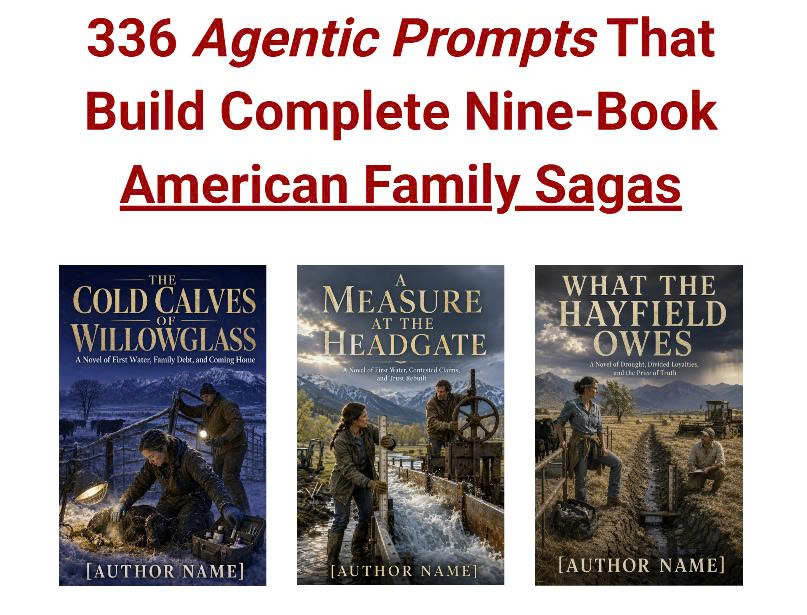
This is most compelling for indie fiction publishers who want systems and continuity rather than isolated AI outputs. The value is not simply “336 prompts.” The real idea is that each prompt acts as the starting architecture for a multi-book dynasty, with persistent canon, planning, writing and publishing instructions built around the same fictional universe.
Most AI Fiction Products Solve the Wrong Problem
There is no shortage of AI writing prompts.
Search almost any marketplace and you can find giant collections promising hundreds or thousands of prompts for romance, mysteries, thrillers, fantasy, children's books and virtually every other genre. The quantity sounds impressive, but the workflow usually remains the same: paste a prompt into a chatbot, receive a scene or outline, copy the result into another document, then try to remember what happened when you return tomorrow.
That approach may be acceptable for short content. It becomes much weaker when the project is a multi-book fiction series.
A family saga is especially unforgiving. You are dealing with births, deaths, marriages, inheritances, old resentments, changing property, shifting relationships, family secrets, historical events, and characters who may appear at several different ages across several different books.
If Book 2 establishes that a character was born in 1961 and Book 6 accidentally makes her 52 years old in 2008, attentive readers can notice. If only one person discovered a letter in Book 3 but everybody inexplicably knows its contents in Book 5, the fictional world starts losing credibility.
That is why I think the central idea behind 336 Agentic Prompts for Family Dynasty Sagas is more important than the raw prompt count.
Paulo is attempting to move the AI from the role of “chatbot that writes paragraphs” toward something closer to a structured production assistant that maintains project files and works from those files throughout the life of the series.
What Exactly Is 336 Agentic Prompts for Family Dynasty Sagas?
Think of it less as a traditional prompt bundle and more as a library of starting engines for building long-form American family saga universes with modern AI agents.
336 Saga Engines
Each prompt is designed around a distinct family-saga concept rather than simply asking the AI to produce a generic story. The goal is to establish characters, history, conflict, legacy assets and a multi-book direction.
Nine-Book Architecture
The system is designed around an extended dynasty rather than a single standalone manuscript. That makes continuity and long-range character planning central to the workflow.
Agent-Based Workflow
The prompts are intended for AI environments capable of working with persistent files, allowing the agent to create and revisit project documents instead of depending entirely on chat memory.
The Six Parts That Make the Concept Interesting
The Architect
The first job is world construction. The agent develops the central family, major personalities, emotional wounds, competing branches, the legacy at the center of the conflict and the broader nine-book direction.
The Planner
Before prose begins, the workflow can develop the individual book package: title, description, keyword direction, cover concept and chapter plan. Importantly, the user gets an approval checkpoint before committing to the manuscript.
The Writer
You can work in a controlled chapter-by-chapter process or use a broader book-generation command. For serious publishing, I would personally favor reviewing work in manageable sections rather than blindly accepting an entire generated novel.
The Memory
This is where the product becomes more interesting to me. After a book is completed, the system is designed to update the permanent family records so later books can work from established dates, relationships, assets, secrets and story state.
The Publisher
The intended workflow does not end with raw text scattered across dozens of conversations. It is designed to assemble a finished book into organized manuscript files, including print and reflowable ebook versions.
The Bridge System
When one saga is finished, the concept does not necessarily stop there. Bridge prompts can move forward into descendants, backward into the founding generation, or sideways into related families and rival branches.
Why the Dynasty Ledger May Matter More Than the 336 Prompts
The part of the product I would pay the most attention to is not the headline prompt count. It is the continuity architecture underneath those prompts.
The workflow uses three persistent layers.
1. Canon Vault
This functions as the saga's authoritative story bible: premise, characters, ages, motivations, family factions, timeline, legacy system and the broad nine-book direction.
2. Dynasty Ledger
This is the permanent record. It can track the family tree, birth and death information, ownership or asset changes, and the status of major secrets — including who knows something, who merely suspects it and what has already been revealed.
3. Writing Protocol
This gives the agent operating rules for the actual production process: revisit canon, preserve established facts and voices, create the manuscript and update the record after completed work.
This is the correct problem to attack.
Modern AI can produce a huge amount of prose. Producing more prose is no longer the difficult part. The difficult part is making Book 7 feel as though it genuinely belongs to the same world established in Book 1.
No automated system should be treated as incapable of making mistakes, and I would still recommend a human continuity review before publishing. But structurally, maintaining explicit canon files is far more sensible than hoping an ordinary chat thread remembers hundreds of thousands of words.
Want to See the Complete System for Yourself?
Take a look at the official offer, the included saga concepts and the current purchase options. If you decide it fits your publishing workflow, purchasing through my link also qualifies you for my exclusive buyer bonus collection.
See 336 Agentic Prompts + Claim My Bonuses →This Is Not Just “A Ranch Story Generator”
The collection is built around multiple forms of American multigenerational fiction, which gives publishers room to test different emotional and historical angles rather than repeating one identical premise.
Legacy & Inheritance
Ranches, farms, businesses, property, wills and family assets can become the physical object around which decades of loyalty, resentment and sacrifice accumulate.
Buried Family Secrets
Letters, old agreements, hidden marriages, adoption revelations, missing relatives and discoveries from earlier generations give the series long-range mystery without turning it into a traditional crime novel.
Clean Slow-Burn Romance
Romance is designed to develop alongside the broader family story, making the concept particularly relevant to publishers interested in emotional, relationship-driven fiction without explicit content.
Historical Braids
Some saga structures can connect present-day events with earlier generations, old documents and historical periods, creating cause-and-effect across decades.
Homecoming Stories
Estranged daughters, reluctant heirs and family members returning to a hometown create a natural entry point for uncovering history while rebuilding relationships.
Dynasty Expansion
Successful families do not necessarily disappear after Book 9. Descendants, founders, rivals and secondary branches can become the foundation of future connected series.
From Initial Concept to a Structured Publishing Package
Another reason I think this product will appeal to KDP publishers is that the workflow tries to address the material surrounding the novel, not only the prose itself.
When a book is planned, the agent can produce a refined identity for the volume together with an Amazon-oriented description, keyword ideas, a cover prompt and a thirteen-chapter structure. You can review that direction before the writing stage begins.
That approval step matters.
“Push a button and publish whatever AI produces” is not a publishing strategy I recommend. AI becomes much more useful when it accelerates production while the publisher remains responsible for quality control, editorial judgment, factual review and the final decision.
In that sense, the strongest interpretation of this product is not:
It is:
That is a much more credible and useful promise.
What Using One of These Saga Engines Could Look Like
| Stage | Your Action | What the System Is Intended to Do |
|---|---|---|
| 1. Choose | Select one saga engine. | Establish the dynasty, characters, legacy conflict, timeline and nine-book architecture. |
| 2. Plan | Ask the agent to plan Book 1. | Prepare book identity, description, keyword direction, cover concept and chapter outline. |
| 3. Review | Approve or request changes. | Refine the plan before committing to long-form prose. |
| 4. Write | Generate by chapter or book. | Draft against the canon and established writing protocol. |
| 5. Audit | Perform your editorial review. | Check prose, dates, character behavior, factual details and overall reader experience. |
| 6. Assemble | Complete the volume. | Organize manuscript versions and update the permanent dynasty record. |
| 7. Continue | Plan Book 2. | Reuse the established canon instead of recreating the entire fictional universe. |
Four Reasons I Think This Is More Interesting Than Another Giant Prompt Pack
1. It starts with architecture instead of prose.
A common mistake with AI fiction is writing immediately. A model can produce attractive paragraphs long before the underlying story is strong enough to support a full novel.
This workflow encourages the opposite: establish the universe, establish the rules, establish the conflicts and build the plan before producing hundreds of pages.
2. It treats continuity as data that should be recorded.
This is exactly what a long series needs. Family relationships, ages, property state and secret state should not live only inside generated prose. They should exist in a reference layer that future books can consult.
3. It gives the user review checkpoints.
The person publishing the books still needs to make decisions. Being able to review a plan before the agent writes the manuscript is a much healthier workflow than completely unattended generation.
4. It is designed around reusable fictional assets.
A strong dynasty becomes more valuable when it can support sequels, prequels and related families. The Bridge concept recognizes that the fictional world itself can become a reusable publishing asset.
The Pros — and What You Should Know Before Buying
What I Like
- Much deeper than ordinary one-shot fiction prompts.
- Built specifically around multi-book continuity.
- Persistent canon and dynasty records make conceptual sense.
- Strong fit for KDP series publishers.
- Planning happens before manuscript generation.
- Can work chapter-by-chapter for better quality control.
- Includes publishing-oriented supporting assets.
- Bridge system gives successful universes room to expand.
- Large variety of family-saga concepts.
- The system emphasizes repeatability rather than random generation.
What You Should Know
- This is not a substitute for human editing.
- You still need to inspect factual and historical details.
- AI-generated prose may require stylistic revision.
- Long books deserve chapter-level quality control.
- No product can guarantee sales, reviews or rankings.
- The best workflow requires learning how the agent files are organized.
- You remain responsible for KDP compliance and final publication decisions.
- If you only want occasional short stories, the system may be more than you need.
Is 336 Agentic Prompts for Family Dynasty Sagas Right for You?
Who should probably skip it?
If you dislike AI-assisted writing entirely, want only standalone flash fiction, or expect an untouched machine-generated manuscript to become a successful book automatically, I would not recommend buying this simply because the headline sounds exciting.
The strongest buyer is someone willing to use the system as a production accelerator while remaining the publisher and quality controller.
My Recommendation: Look at the Workflow, Not Just the Prompt Count
If persistent canon, nine-book planning and an agent-driven production workflow solve a real problem for you, this is one of the more distinctive AI fiction offers I have reviewed recently.
Check the Current Offer on WarriorPlus →A Quick Note About the Funnel
At the time this review was prepared, the front-end offer was presented as 336 Agentic Prompts for Family Dynasty Sagas, with additional optional upgrades in the funnel offering substantially larger prompt collections.
| Offer Level | Prompt Collection | Price Presented |
|---|---|---|
| Front End | 336 Agentic Prompts | $17 |
| OTO 1 | 720 Agentic Prompts | $27 |
| OTO 2 | 2,905 Agentic Prompts | $67 |
| OTO 3 | 6,999 Agentic Prompts | $97 |
| OTO 4 | 19,808 Agentic Prompts | $197 |
Prices, funnel configuration and availability may change after this review is published. Always confirm the current terms on the official WarriorPlus checkout page before purchasing. Optional upgrades are not required simply because they are offered.
My Overall Assessment
My score reflects the concept, workflow and potential usefulness to the intended publisher. It is not a guarantee of financial or publishing results.
If You Decide to Buy, I Am Adding Something Much Bigger
Paulo's system focuses on creating the saga. I wanted my bonus to help buyers with the surrounding publishing, quality-control, reader-growth and implementation work that still exists after the AI has produced the manuscript.
So instead of adding another pile of generic fiction prompts to a product that already contains hundreds — and potentially thousands through the optional funnel — I am including access to my own premium publishing resource collection for qualifying customers who purchase through my link.
Publishing & KDP Resources
Practical resources designed to help creators organize, prepare, package and publish digital and book-based products more efficiently.
AI Creation Resources
Additional systems, templates and implementation resources covering AI-assisted content creation, visual production and digital publishing workflows.
Marketing Resources
Materials focused on positioning, promotion, audience building, sales assets and practical marketing implementation.
Creator Business Resources
Tools and training materials intended to help creators turn individual outputs into better organized reusable business assets.
Templates & Checklists
Ready-to-use support materials designed to reduce blank-page work and make common publishing and creator tasks easier to execute.
Exclusive Ann Le Resources
Selected resources from my own creator library that are not part of Paulo's core Family Dynasty Saga product.
The $100 K + figure represents the combined stated retail value assigned to the included digital resources and is not cash value, resale value, an income claim, or a guarantee of results.
Is 336 Agentic Prompts for Family Dynasty Sagas Worth Looking At?
I review a lot of products built around AI prompts, and most are ultimately collections of instructions that produce isolated outputs.
This one is conceptually different.
The product is trying to solve the much harder problem of maintaining a long fictional universe while AI continues creating inside it.
The Architect establishes the world. The Planner turns that world into a reviewable book plan. The Writer produces the chapters. The Memory system preserves what changed. The Publisher organizes the finished manuscript. And the Bridge concept gives a successful fictional family somewhere to go after its first nine-book arc.
That does not eliminate the need for editing, fact checking, proofreading or human creative judgment. I would be suspicious of any product claiming otherwise.
What it can potentially eliminate is a large amount of repetitive setup, manual continuity management and “where did I put that information?” friction.
For an indie publisher who already understands that AI should be supervised rather than blindly trusted, that is a meaningful improvement.
My conclusion: if your goal is to build connected, multi-book family sagas rather than generate random fiction on demand, this is one of the more thoughtfully structured agentic-prompt concepts I have seen.
And if you decide to get it, use the button below so your purchase is tracked through my affiliate link and you can receive my exclusive $100,000+ stated-value resource collection as part of this promotion.
Please review the official product page and current WarriorPlus checkout terms before making a purchase. Prices and availability may change.
Results Disclaimer: Nothing on this page is a guarantee of book sales, rankings, royalties, reader engagement, income or other publishing results. AI-assisted content should be reviewed, edited, fact-checked and checked against the requirements of the publishing platforms you use.
Bonus Value Disclosure: The stated $100 K+ bonus value represents the combined stated retail value assigned to digital resources included in this affiliate promotion. It is not a cash equivalent, resale guarantee, income claim or prediction of the financial benefit any buyer will receive.