AI Can Give You a Haunted House in 30 Seconds. Keeping the Mystery Believable for 40 Chapters Is Where It Usually Falls Apart.
You start with a great premise. The abandoned house feels creepy. The investigator has a secret. The first supernatural clue lands perfectly.
Then Chapter 11 arrives. The ghost suddenly breaks its own rules. A character's backstory changes. An important clue disappears. The middle starts repeating the same scares. And the final reveal depends on information the reader was never actually given.
That is the problem Ghost Mystery Royalties Bot is trying to solve: design the mystery, haunting and ending first — then write toward them.

View the current offer and purchase terms through the official checkout.

What Exactly Is Ghost Mystery Royalties Bot?
Ghost Mystery Royalties Bot is a specialized Custom GPT built around ghost, haunted-house and paranormal mystery publishing.
It is not primarily selling “AI that can write.” Modern AI can already write.
The real product is the workflow wrapped around the model.
The Blank Page Is No Longer the Enemy. The 30,000 Words After It Are.
AI has changed the fiction-production problem.
A few years ago, writers worried about producing enough words. Today, almost anyone can generate thousands of words before lunch.
But more words create more things that must stay consistent.
A mystery novel needs to remember:
who knows the secret, which clues have appeared, what time an event happened, why a suspect lied, what the reader is supposed to believe and what the ending must eventually explain.
A ghost mystery adds another layer:
What can the ghost do? Why is it there? What triggers it? What can stop it? Which manifestations are real clues?
The AI Starts Writing Before the Mystery Exists
The opening may sound impressive, but by Chapter 12 you discover there was never enough underlying logic to support the ending.
Characters Quietly Drift
Motivations, memories, relationships and personal histories can change as the manuscript grows.
The Ghost Has Convenient Powers
If the supernatural element can suddenly do anything the plot requires, tension disappears because the world no longer has reliable rules.
Clues Go Nowhere
Early evidence gets forgotten, while the ending introduces explanations the reader never had a fair chance to discover.
The Middle Becomes “Another Creepy Noise”
Another shadow. Another cold room. Another door moving by itself. Atmosphere without escalation eventually becomes repetition.
A Draft Is Still Not a Publishing Product
Even after the novel exists, you still need positioning, description copy, keywords, author identity and cover material.
Ghost Mystery Royalties Bot Tries to Solve the Structure Before It Solves the Prose
This is where the product makes the most sense to me.
Instead of treating a novel as one giant generation command, the workflow divides the project into stages.
Choose the Paranormal Direction
Establish the type of ghost, haunting, haunted location or paranormal mystery you want to build around.
Build the Story Bible Before Chapter One
Define the setting, central characters, investigator, supporting cast, haunting, mystery and intended final reveal before the manuscript begins drifting.
Draft Chapter by Chapter
The manuscript is developed progressively, giving you natural opportunities to read, edit and redirect the story instead of waiting until a giant draft is complete.
Move From Manuscript to Publishing Assets
The workflow continues into supporting materials such as keyword ideas, Amazon description copy, author positioning and cover output.
The Beginner Problem Is Often Not “I Need More Prompts.” It Is “What Do I Do Next?”
A 300-prompt pack can still leave a beginner confused.
Which prompt comes first? What information needs to be saved? When should the Story Bible be locked? Which outputs should influence later chapters? What happens when you return tomorrow?
A guided bot reduces that decision burden.
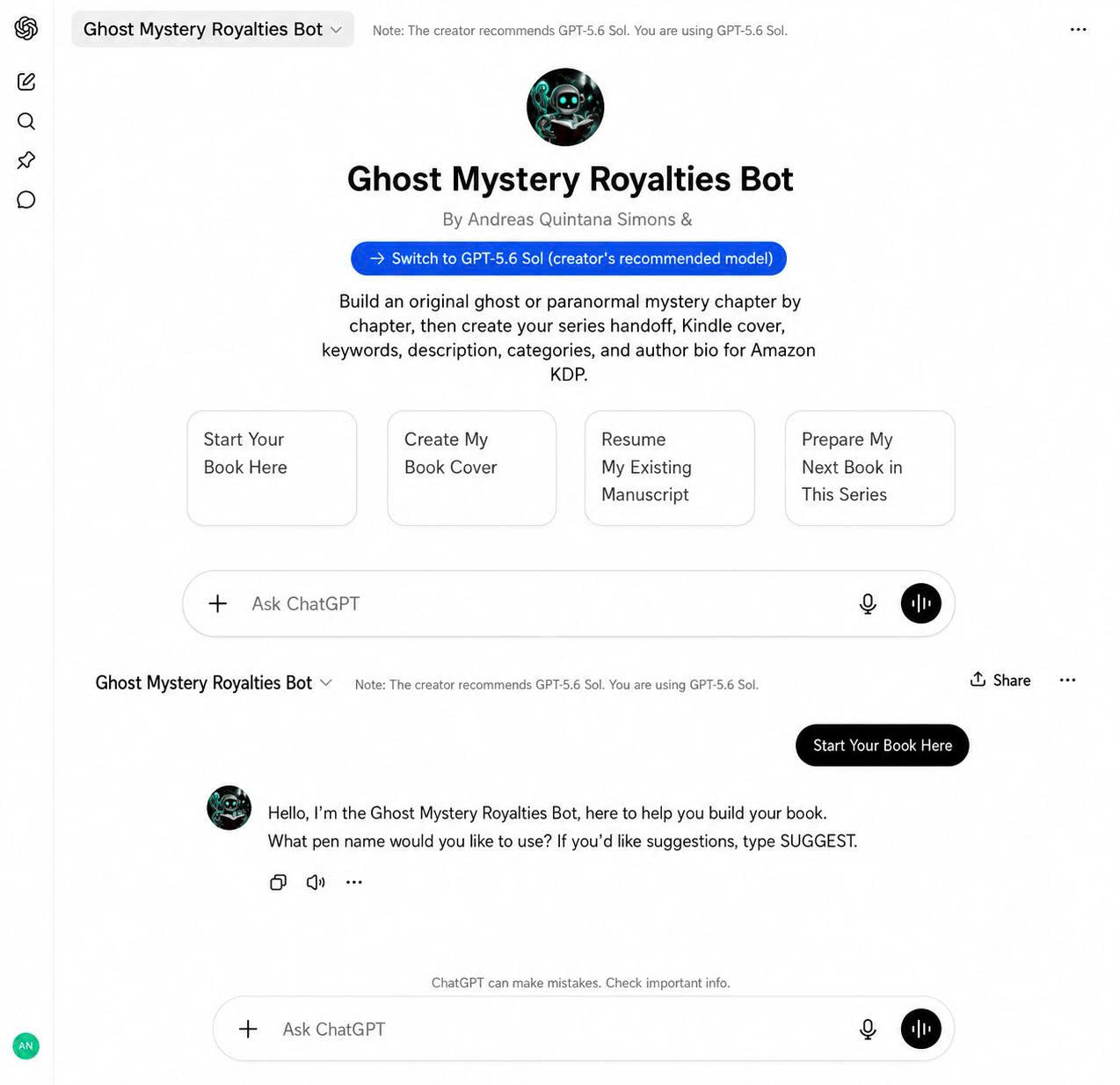
The product uses a guided ChatGPT workflow rather than requiring the buyer to design a complete prompt chain independently.
The Feature I Would Pay For Is Not “AI Writing”
I can already open a general AI assistant and ask it to write a ghost story. That capability by itself is not unusual anymore.
What I find more useful here is the predefined sequence of decisions: define the haunting, define the mystery, lock the reveal, build the Story Bible, then move into controlled drafting.
That is what potentially saves the buyer time — not access to some secret form of artificial intelligence.
What You Actually Get
Ghost Mystery Custom GPT
A genre-specific environment focused on paranormal and ghost mystery rather than general-purpose fiction.
Four-Stage Production Workflow
Connects concept development, Story Bible creation, chapter drafting and publishing preparation.
Story Bible Development
Establishes characters, setting, atmosphere, haunting, central mystery and intended reveal.
Chapter-by-Chapter Drafting
Progressive manuscript generation gives the publisher regular review and editing opportunities.
20- or 40-Chapter Paths
Two different novel-length structures provide a clearer target than an undefined “keep writing until the book feels finished” workflow.
Pen Name & Author Persona
Supports creation of a genre-facing author identity and author-bio material.
KDP Listing Support
Includes seven buyer-intent keyword ideas plus Amazon description copy.
Finished Cover Output
The workflow is designed to move beyond a cover prompt and produce an actual AI-generated cover image inside ChatGPT.
| Stage | What the Bot Helps With | What You Should Still Do |
|---|---|---|
| Concept | Haunting, genre direction and mystery foundation. | Choose an idea that fits your intended reader. |
| Story Bible | Characters, setting, paranormal rules and final reveal. | Review the logic and personalize generic elements. |
| Draft | Chapter-by-chapter prose generation. | Edit voice, repetition, pacing and continuity. |
| Listing | Keyword ideas and description support. | Validate positioning against the current marketplace. |
| Cover | AI-generated finished visual output. | Check genre expectations, typography and commercial suitability. |
A Good Story Bible Is Useful Only If the Workflow Actually Continues Into the Draft
Some AI writing tools look excellent during brainstorming and then effectively leave the user alone when real manuscript production starts.
Ghost Mystery Royalties Bot is designed to continue into chapter drafting.
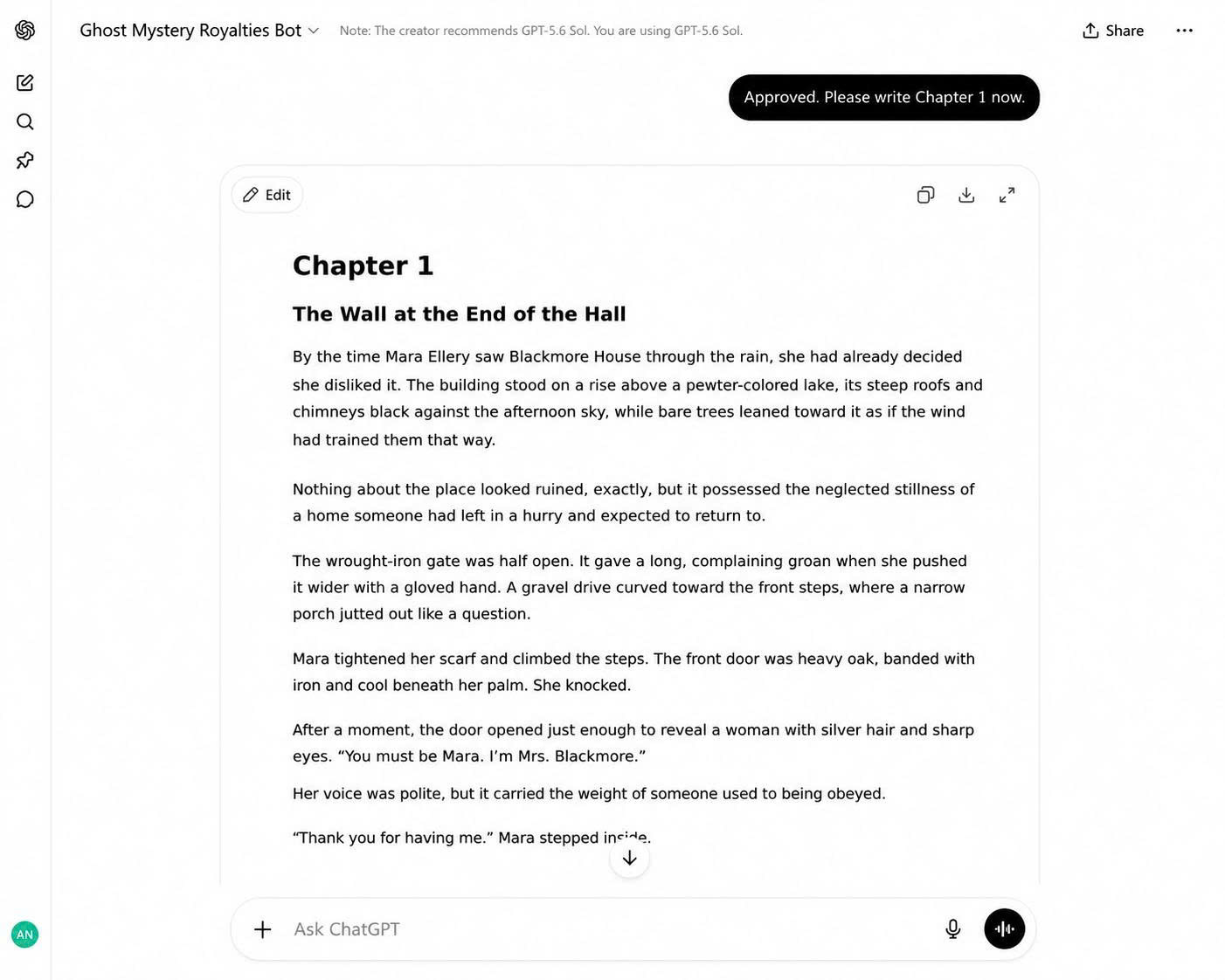
Chapter generation takes place inside the guided workflow so the draft can be reviewed as the mystery develops.
I would still call the result a first draft.
AI may write a strong scene and still repeat expressions. It may create atmosphere and still over-explain emotion. It may remember 95% of the timeline and still introduce one contradiction.
Could You Do This With Normal ChatGPT?
Yes.
A capable general AI assistant can brainstorm hauntings, create characters, outline mysteries and draft chapters.
The underlying AI intelligence is not the key reason to buy this product.
The question is whether you want to personally design and maintain:
- the initial discovery questions;
- the Story Bible structure;
- the haunting rules;
- the clue and reveal architecture;
- the chapter-production sequence;
- the continuity process;
- the resume-after-a-break workflow;
- the author-positioning process;
- the KDP listing assets;
- and the repeatable system for Book Two.
It can.
The real comparison is “Do I want to build the entire production system myself?”
What About the Ghost Mystery Opportunity?
The vendor presents research around ghost, haunted-house and paranormal categories and uses market examples to support the publishing angle.
I think that is useful as a reason to investigate the niche.
I would not interpret it as evidence that every ghost mystery automatically sells.
Amazon rankings change. Competition changes. Reader tastes change. And revenue-estimation tools remain estimates.
So the responsible interpretation is:
Not:
“Buy a bot and Amazon automatically sends royalties.”
The More Interesting Use Case May Be a Series — Not One Isolated Book
A reusable publishing workflow becomes more valuable when it can support multiple connected books.
Paranormal mystery naturally lends itself to recurring structures:
Recurring Investigator
A consistent protagonist handling a different supernatural case each book.
Psychic Medium Series
A recurring medium encountering different hauntings and unresolved histories.
Haunted Locations
Each volume explores another property with its own paranormal mystery.
Supernatural Small Town
Individual mysteries gradually reveal a larger connected mythology.
Once Book One exists, the questions become different:
Which paranormal rules are already established?
Who knows which secrets?
Which unresolved thread can return later?
What belongs to Book Three instead of Book Two?
Ghost Mystery Royalties Bot: Pros & Cons
What I Like
- Very clear specialization. It is built around one specific fiction category.
- Story Bible before manuscript. This is much more sensible than immediately generating tens of thousands of words.
- Chapter-by-chapter workflow. Natural review points make quality control easier.
- The final reveal is considered early. Important for any mystery-driven book.
- It moves beyond brainstorming. The workflow continues into manuscript and publishing assets.
- 20- and 40-chapter structures. Useful for giving the project defined scope.
- Pen-name, listing and cover support. Helps move the output closer to an actual publishing project.
What You Need to Keep in Mind
- AI-generated prose still needs editing.
- Story Bibles reduce continuity risk but do not eliminate mistakes.
- Comedy, atmosphere, tension and fear remain subjective.
- Keyword suggestions should still be validated against the current market.
- AI cover output still requires inspection.
- No bot can guarantee KDP rankings, sales or royalties.
- An experienced prompt engineer may already have a similar personal workflow.
Purchase Through This Review and Receive My Ghost Mystery Bonuses + $119K Resource Vault
If you decide Ghost Mystery Royalties Bot fits your publishing workflow, qualifying purchases made through one of the buttons on this review also receive my separate buyer bonus offer.
This bonus package is provided separately from the standard vendor product.
The purpose is to complement the core bot with additional resources around publishing, continuity, series development and broader creator workflows rather than simply adding another pile of generic ghost-writing prompts.
Complete your purchase through one of the WarriorPlus buttons on this page so the order is attributed to this promotion.
Purchases made through another affiliate or another promotional page may not qualify for this separate bonus package.
Bonus resources do not imply guaranteed sales, royalties or income.
Ghost Mystery Royalties Bot FAQ
What is Ghost Mystery Royalties Bot?
It is a specialized Custom GPT designed around ghost, haunted-house and paranormal mystery publishing workflows.
Is it just a prompt pack?
No. The product is structured around a guided sequence that moves from concept and Story Bible creation into chapter drafting and publishing support.
Does it write the book?
The system supports chapter-by-chapter manuscript generation. I would still treat AI-generated prose as a draft that requires human review and editing.
What book lengths does it support?
The offer describes approximately 20-chapter and 40-chapter production paths.
What is the Story Bible for?
It establishes the major characters, setting, haunting, mystery logic and intended reveal before long-form drafting begins.
Does it help with KDP assets?
The workflow includes support for seven buyer-intent keyword ideas, Amazon description copy, pen-name/author material and cover output.
Can ordinary ChatGPT do similar tasks?
Yes. The main value proposition is the predefined genre-specific workflow rather than access to unique underlying AI intelligence.
Does this guarantee book sales?
No. Book quality, niche demand, competition, cover design, positioning, pricing, reviews and marketing all affect publishing performance.
How do I qualify for your bonuses?
Use one of the affiliate purchase buttons on this review page so your order can be attributed to this promotion.
Ghost Mystery Royalties Bot Makes the Most Sense When You Stop Thinking About “AI Writing” and Start Thinking About Mystery Architecture
AI writing itself is no longer rare.
What remains difficult is creating a long story where the characters, haunting, clues, red herrings, paranormal rules and final reveal still belong to the same intentional mystery 30 chapters later.
That is where I think this product has its clearest reason to exist.
It gives the user a defined path:
Concept → Story Bible → Controlled Drafting → Publishing Assets
I would not use it to generate a novel and immediately upload whatever appears.
I would use it to remove a large amount of planning, prompt-engineering and blank-page friction — then apply human editing and publishing judgment to the result.
For a beginner or KDP publisher specifically interested in paranormal mystery, that can be considerably more useful than another generic “write anything” AI tool.
Check the current product details, price and purchase terms on the official offer.