Jikan Nazo Review: A Different Kind of KDP Puzzle Engine — And One of the More Interesting Concepts I’ve Seen Lately
Most KDP puzzle tools help you make more of what already exists: word searches, mazes, Sudoku, crosswords and familiar activity books. Jikan Nazo takes a different route. It is built around a specialized “Find-the-Number” elimination mystery where one number is guilty, every clue removes suspects, and exactly one answer should remain.
That distinction matters. The biggest challenge for low-content and puzzle publishers today is not simply producing pages faster. Software can already do that. The harder problem is finding a concept that feels sufficiently different from the thousands of near-identical puzzle books already competing for attention.
Jikan Nazo is interesting because it is not merely another layout generator. At its core is a logic engine designed to create complete number-elimination mystery books, verify the puzzle structure, format the book and produce the supporting pages needed to turn the puzzle into a publishable product.
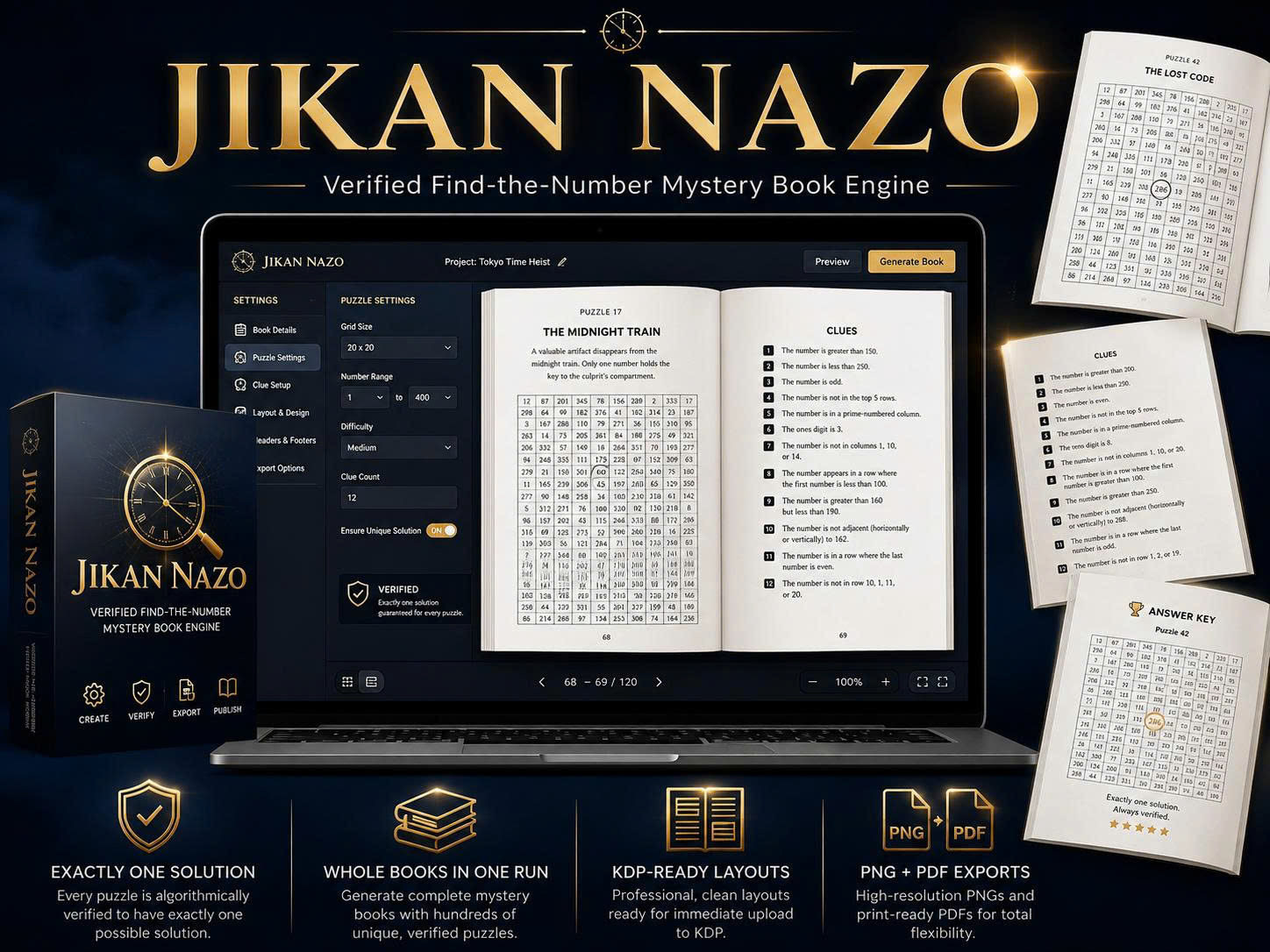
Conceptual overview of the Jikan Nazo workflow and the types of puzzle-book assets the engine is designed to create.
Bonus eligibility applies only when Jikan Nazo is ordered through a link or button on this review page.
What Exactly Is Jikan Nazo?
Jikan Nazo is a specialized puzzle-book creation engine for people who want to publish number-based mystery and logic books on Amazon KDP or sell similar material as printable products.
Instead of giving the reader a conventional number grid and asking them to solve a mathematical equation, Jikan Nazo turns a list or register of numbers into a process-of-elimination mystery.
Imagine opening a puzzle and seeing dozens, hundreds or potentially thousands of numbers. Somewhere inside that register is the target number. The reader then receives a sequence of clues such as whether the answer is odd or even, whether it contains a certain digit, whether it falls within a particular range, or whether it satisfies another structural condition.
Each clue eliminates more possibilities. The reader continues investigating until only one candidate remains.
Conceptually, it combines the satisfaction of a logic puzzle with the framing of a miniature investigation. That is why the vendor positions the product as a “Find-the-Number mystery engine” rather than a generic number-puzzle generator.
How Does a Jikan Nazo Puzzle Actually Work?
Understanding the underlying puzzle makes the rest of the software much easier to evaluate.
A Jikan Nazo puzzle begins with what the vendor calls a register: essentially a collection of number entries. One entry is designated as the correct answer.
The engine then constructs clues that progressively remove incorrect candidates. A simplified example might look like this:
Example Elimination Logic
Clue 1: The number is even.
Clue 2: Its digits add up to more than 15.
Clue 3: The number does not contain a zero.
Clue 4: It falls within a particular numerical range.
The reader crosses out every number that violates the clues. Eventually, one number should remain.
On the surface, that sounds easy to create manually. In practice, building a good elimination puzzle at scale is more complicated than it appears.
Every clue has to be compatible with the target answer. The complete set of clues must narrow the register down to one survivor. And if you want a tightly constructed logic puzzle rather than a sloppy worksheet, the clues should contribute meaningfully instead of including unnecessary filler.
This is where Jikan Nazo’s verification engine becomes much more important than the number generator itself.
The Verification Engine Is the Part I Would Pay Attention To
If I were evaluating Jikan Nazo purely as “software that generates number pages,” I would not find the offer especially interesting. There are many ways to generate random datasets.
The stronger proposition is that the engine is designed to verify the logic before the book is exported.
According to the product description, the system checks that the finished puzzle resolves to exactly one answer. The vendor also emphasizes clue necessity: the goal is not simply to produce a list of statements that happen to describe the answer, but to create an elimination structure where the clues genuinely contribute to solving the case.
For puzzle publishing, that matters.
A formatting mistake is annoying. A logically broken puzzle is much worse. If customers reach the end of a puzzle and discover that two answers are possible — or no answer satisfies all the clues — the credibility of the entire book can disappear quickly.
A verification layer therefore addresses a real production problem: quality control.
This does not mean publishers should stop reviewing their exported books. I would still inspect samples, check formatting and test the final files before uploading them anywhere. Automation should reduce manual checking, not eliminate responsible publishing.
But compared with manually designing hundreds of elimination puzzles, having a system built around validation is a meaningful advantage.
Jikan Nazo Is Designed to Build Books, Not Just Puzzle Pages
Another reason I think this offer is more interesting than a typical small puzzle generator is the emphasis on whole-book production.
The vendor states that Jikan Nazo can handle projects containing up to 42,000 entries and generate the broader structure around the puzzle in a single workflow.
That includes more than the number register itself.
Number Registers
The main suspect pool used by the reader during the elimination process.
Clue Pages
Structured elimination clues that guide the reader toward the surviving answer.
Rules & Instructions
Supporting pages that explain how the puzzle works instead of forcing the publisher to assemble instructions separately.
Answer Material
Answer-key components, coded-answer pages and reveal pages for a more complete book experience.
Front Matter
Elements such as ownership and rules pages help turn raw puzzle output into a more complete interior.
Book Structure
Chapter titles, page numbering and supporting layout options help the project feel like a finished book rather than disconnected worksheets.
This is an important distinction for the target buyer.
Most KDP publishers are not looking for another tool that gives them “Puzzle #1” and then leaves them to spend the next two hours inside Canva, Word or another design application assembling everything manually.
The more of that process a tool can reasonably handle, the more valuable it becomes to someone trying to build an actual catalog.
What Can Come Out of the Engine?
The visual below gives a much clearer picture of the product concept. You are not dealing with one isolated grid. The intended output includes several page types that work together as a puzzle-book system.
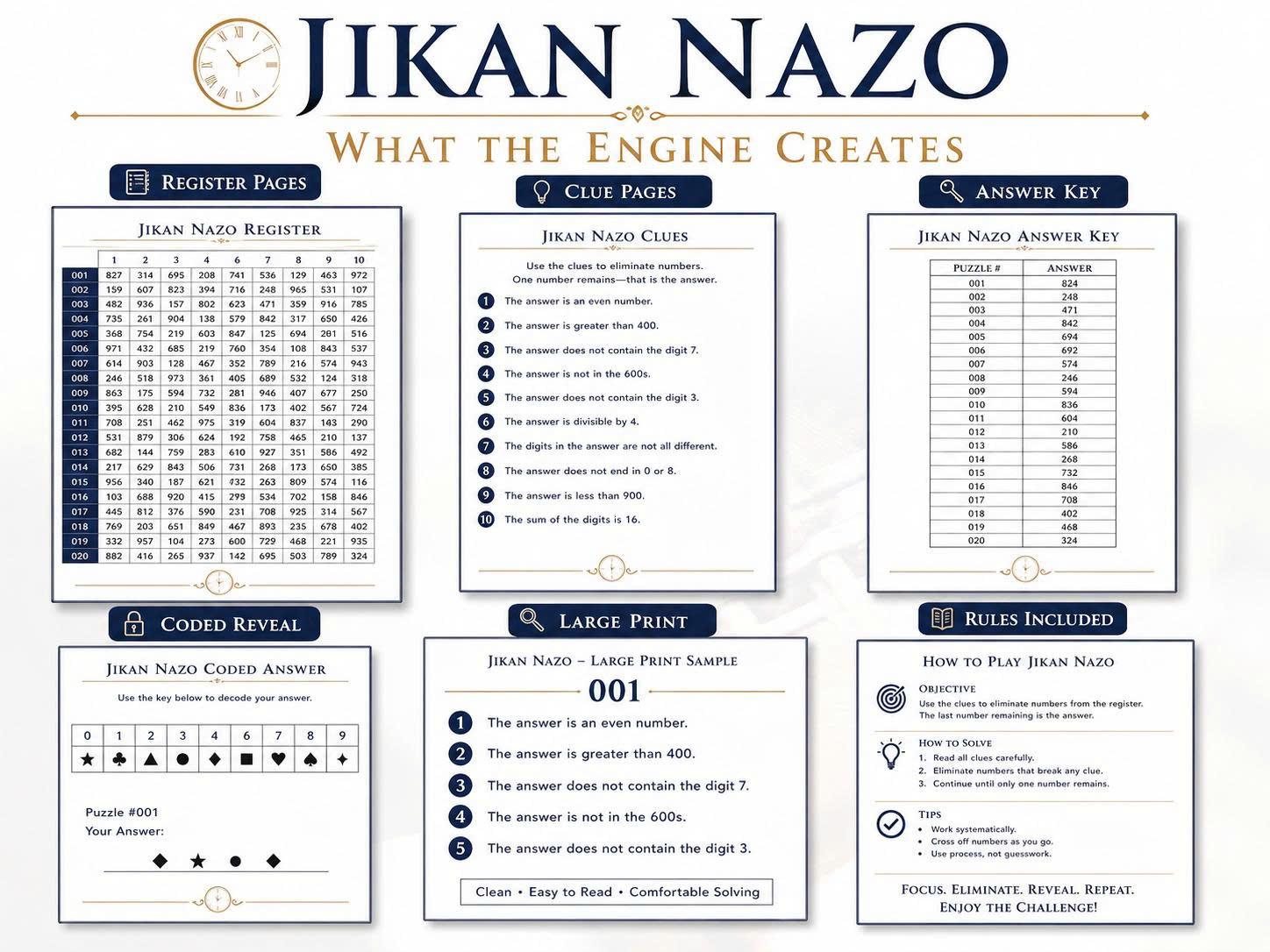
For me, this is where Jikan Nazo starts to make more sense as a publishing product. The software is attempting to connect puzzle generation, logic verification and book assembly rather than treating each one as a completely separate job.
Order through this review page to qualify for my separate $119K Bonus Bundle.
How the Creation Process Is Supposed to Work
The workflow is deliberately simple, which is appropriate for this market. The intended user should not need to understand the mathematics or programming behind the elimination engine.
Choose the Book Settings
You select the relevant project options, including difficulty, register size and book-formatting choices. The product includes three named difficulty levels: Gentle, Standard and Fiendish.
Generate and Verify
The engine builds the register and clue structure and checks the puzzle logic. The key promise here is not merely generation speed; it is generation plus validation.
Review the Book
You can inspect the assembled project, including its puzzle pages, clue material and supporting book pages. I would personally make this review step part of every publishing workflow even when the engine reports that the logic is valid.
Export for Publishing or Printable Use
The product is designed around both high-resolution image output and print-ready PDF workflows, giving publishers more than one way to repurpose the material.
KDP Formatting Is Another Important Part of the Offer
Puzzle creation is only half of a KDP workflow. You still need an interior that fits the intended trim size, respects margins and gutters, remains readable in print and does not become a formatting headache during upload.
Jikan Nazo includes publishing-oriented controls for common trim and layout considerations, including margins, gutter handling, bleed options, mirrored margins, page numbers and large-print formatting.
The vendor also describes a pre-flight checking process intended to help publishers catch book-layout problems before uploading the file.
I would not interpret that as a reason to skip Amazon’s own preview process. You should still inspect the final manuscript in the platform’s preview environment and verify that the result meets current requirements.
But having publishing logic built into the application can save considerable manual work compared with generating puzzle assets first and rebuilding every interior from scratch afterward.
| Capability | Why It Matters |
|---|---|
| Multiple Trim Sizes | Lets publishers adapt the same core concept to different book formats instead of designing only one fixed page size. |
| Margins & Gutter | Important for paperback readability, particularly when puzzle content approaches the inner binding area. |
| Mirrored Margins | Useful for interiors where left and right pages require different inner-margin treatment. |
| 18pt Large Print | Creates an additional format opportunity for readers who prefer larger, easier-to-read puzzles. |
| Pre-Flight Checking | Adds another quality-control step before final publishing. |
One Engine Can Support Several Publishing Angles
A good publishing tool becomes more useful when the same underlying engine can support multiple products rather than a single one-off book.
Jikan Nazo appears well suited to that approach.
1. Standard Find-the-Number Puzzle Books
This is the obvious starting point: traditional collections built around the elimination mechanic. Different themes, titles, register sizes and difficulty settings could help separate individual books inside a catalog.
2. Difficulty-Ladder Series
Because the engine includes Gentle, Standard and Fiendish difficulty options, publishers could organize products around progressive challenge levels rather than selling every book to the same reader.
3. Large-Print Editions
Built-in 18pt formatting creates an obvious path toward large-print editions. That does not automatically guarantee demand, but it does allow the same puzzle framework to address readers who prioritize comfortable readability.
4. Travel and Activity Books
Number-elimination puzzles can work as short, self-contained activities for waiting rooms, road trips, holidays and other situations where readers want something they can solve in relatively small sessions.
5. Classroom or Printable Logic Activities
Because the output can also be used outside paperback publishing, educators and printable sellers may find opportunities to package selected puzzles as logic challenges, brain teasers or activity sheets.
6. Personalized and Themed Projects
The software includes support for custom number imports and custom chapter titles, opening the door to themed or personalized variations rather than requiring every book to use the same default dataset.
A Reality Check on the “New Niche” Angle
The vendor markets number-mystery books as an unusually open publishing opportunity. I would treat that as a marketing angle rather than a guarantee. Competition, search demand and reader interest can change. Use niche research, good covers, sensible keywords and strong product positioning just as you would with any other KDP category.
What About Exports?
The offer includes unlimited high-resolution PNG exports and a PDF allowance described by the vendor as up to 100 print-ready PDFs per month.
That distinction is worth noting because “no recurring fees” does not necessarily mean every export format is unlimited without any monthly usage allowance.
For most individual publishers, 100 complete PDF exports in a month may already represent substantial production capacity. But higher-volume users should understand the difference before buying.
Having both image and PDF output also gives the system more flexibility. A complete PDF can be used for book production, while individual high-resolution page images may be useful for previews, printable packs, promotional graphics or additional layout workflows.
Jikan Nazo Pros and Cons
What I Like
- A genuinely different puzzle mechanic. It is not simply another word-search or Sudoku generator.
- Verification is central to the product. Logical correctness is more valuable than merely generating pages quickly.
- Whole-book generation. The product attempts to handle supporting pages instead of stopping at raw puzzle output.
- Three difficulty levels. Useful for creating product variations and series.
- KDP-oriented formatting. Trim, margins, gutter, large print and pre-flight features reduce additional production work.
- Custom imports. Using your own number lists and chapter titles gives the engine more flexibility.
- Multiple export paths. PNG and PDF output support both paperback and printable workflows.
- Commercial-use focus. The offer is designed for people who want to create products they can publish or sell.
What to Keep in Mind
- Software does not create buyer demand automatically. You still need niche research, packaging and marketing.
- The puzzle format is specialized. That differentiation is a strength, but not every publisher will want to build a catalog around number mysteries.
- You should still review exports. Verification technology is helpful, but publishers remain responsible for final quality control.
- PDF output has a monthly allowance. The vendor describes unlimited PNG exports but 100 PDF exports per month.
- “Low competition” can change quickly. Never assume a niche will stay empty simply because it is newer.
Jikan Nazo Makes the Most Sense for These Buyers
I think the strongest fit is someone who is already interested in KDP puzzle publishing or printable products but wants an alternative to competing exclusively in mature puzzle categories.
It could be particularly useful if you:
- want a specialized puzzle format rather than another generic puzzle generator;
- prefer software that creates complete book structures instead of individual pages;
- are concerned about puzzle correctness and want built-in verification;
- want to create several difficulty levels from one underlying concept;
- want large-print options without manually rebuilding every page;
- publish both Amazon paperbacks and downloadable printable products;
- want the ability to import custom numbers and create themed variations;
- value speed but still intend to review and polish what you publish.
Who Probably Does Not Need It?
If you are not interested in puzzle books, KDP, printables or number-based logic games, this is obviously not a necessary purchase.
It is also not the right product for someone looking for a push-button guarantee of passive income. Jikan Nazo can handle part of the production process. It cannot decide whether your cover is appealing, whether your chosen title attracts search traffic, whether the niche has sufficient buyers, or whether your broader publishing strategy is sound.
Think of it as production infrastructure, not a money machine.
Order Through This Review and Get My $119K Bonus Bundle
If you decide Jikan Nazo is right for your publishing workflow, I am adding a separate bonus bundle for readers who purchase through the links on this page.
The purpose of my bonus package is to add extra resources around digital publishing, content creation, marketing and related business workflows so you have more material to work with beyond the core Jikan Nazo software.
This bonus is provided independently by me and is separate from the bonuses offered directly by the Jikan Nazo vendor.
The bonus does not imply guaranteed income or business results. Results depend on how you use the product, your market and your publishing strategy.
The Vendor Also Includes Launch Bonuses
Separate from my own bonus package, the Jikan Nazo offer describes additional tools intended to support the publishing workflow.
PDF Page Mover
Designed to help reorder, insert, move or remove pages inside an existing PDF without rebuilding an entire project.
KDP Keyword Finder
A supporting research tool aimed at helping publishers identify terms for their Amazon KDP keyword fields.
Description Helper
Designed to speed up creation of book descriptions and reduce the blank-page problem when preparing a listing.
My Separate Bonus Bundle
Buyers referred through this review also qualify for my separate $119K Bonus Bundle, subject to the purchase-tracking condition explained above.
Jikan Nazo FAQ
Is Jikan Nazo an ebook or training course?
No. The core offer is a software engine designed to generate Find-the-Number elimination-mystery puzzle books and associated publishing assets.
Do I need to write mystery stories?
The product is not primarily a story-writing system. Its “mystery” framing comes from the investigative elimination mechanic: one number is the target, and the clues progressively identify it.
Do I need advanced math skills?
The point of the engine is to handle the underlying generation and verification process. The user works through settings rather than manually engineering the logic for every puzzle.
Does Jikan Nazo create full books?
That is one of its core selling points. It is designed to generate registers, clues, answer material, rules, supporting pages and formatted book content rather than exporting only a single puzzle.
How many entries can it handle?
The vendor states that whole-book generation can support projects containing up to 42,000 entries.
What difficulty levels are available?
The product includes three levels: Gentle, Standard and Fiendish.
Can I create large-print books?
Yes. Large-print formatting at 18pt is among the features described in the offer.
Does it support KDP formatting?
Jikan Nazo includes publishing-oriented features for trim sizes, margins, gutter, bleed, mirrored margins, page numbering and pre-flight checking. You should still inspect the final manuscript using the publishing platform’s own preview tools before going live.
Can I sell the output?
The offer is positioned for commercial publishing and printable use, with the vendor stating that users retain commercial rights to the books they create.
What export formats are included?
The offer describes unlimited high-resolution PNG exports plus an allowance of up to 100 print-ready PDF exports per month.
Can I use my own numbers?
Yes. Custom number imports and custom chapter titles are part of the stated feature set.
Does buying Jikan Nazo guarantee KDP sales?
No. No software can guarantee royalties, rankings or sales. Product quality, niche demand, positioning, cover design, keywords, pricing, competition and marketing all influence publishing results.
How do I qualify for Ann Le’s $119K Bonus Bundle?
Complete your Jikan Nazo purchase through one of the affiliate links or buttons on this review page. The bonus is tied to purchases attributed to this page and cannot be attached retroactively to orders placed through another source.
Is Jikan Nazo Worth Considering?
If you evaluate Jikan Nazo as another generic “make low-content books fast” tool, you miss the part that makes it interesting.
Its strongest idea is the combination of a specialized puzzle mechanic, automated logic verification and whole-book production.
The number-elimination format gives publishers something different from the standard word-search, maze and Sudoku categories, while the verification layer addresses one of the biggest risks in puzzle production: publishing an activity that does not actually solve correctly.
Add the KDP-oriented layout controls, large-print option, custom imports, answer-key system and multiple export formats, and Jikan Nazo becomes more than a simple number generator.
I would still approach it like a publisher rather than a lottery ticket. Research your market. Review your files. Create professional covers. Test your listings. Build a catalog strategically rather than flooding a marketplace with near-identical books.
But if the Find-the-Number mystery concept interests you and you want software built specifically around that format, I think Jikan Nazo is one of the more distinctive puzzle-publishing tools worth examining.
My bonus applies only to purchases completed through the links on this review page.