Micro Drama Empire Review
A connected short-form storytelling workflow built around recurring characters, episode continuity and cliffhangers.
Read Review →Creating one Sudoku page is easy. Creating one memory worksheet is easy. The difficult part is turning multiple types of recall, focus, logic, word and spatial activities into one coherent workbook — with clear instructions, correct answer keys, consistent layouts and files that are actually ready for print.

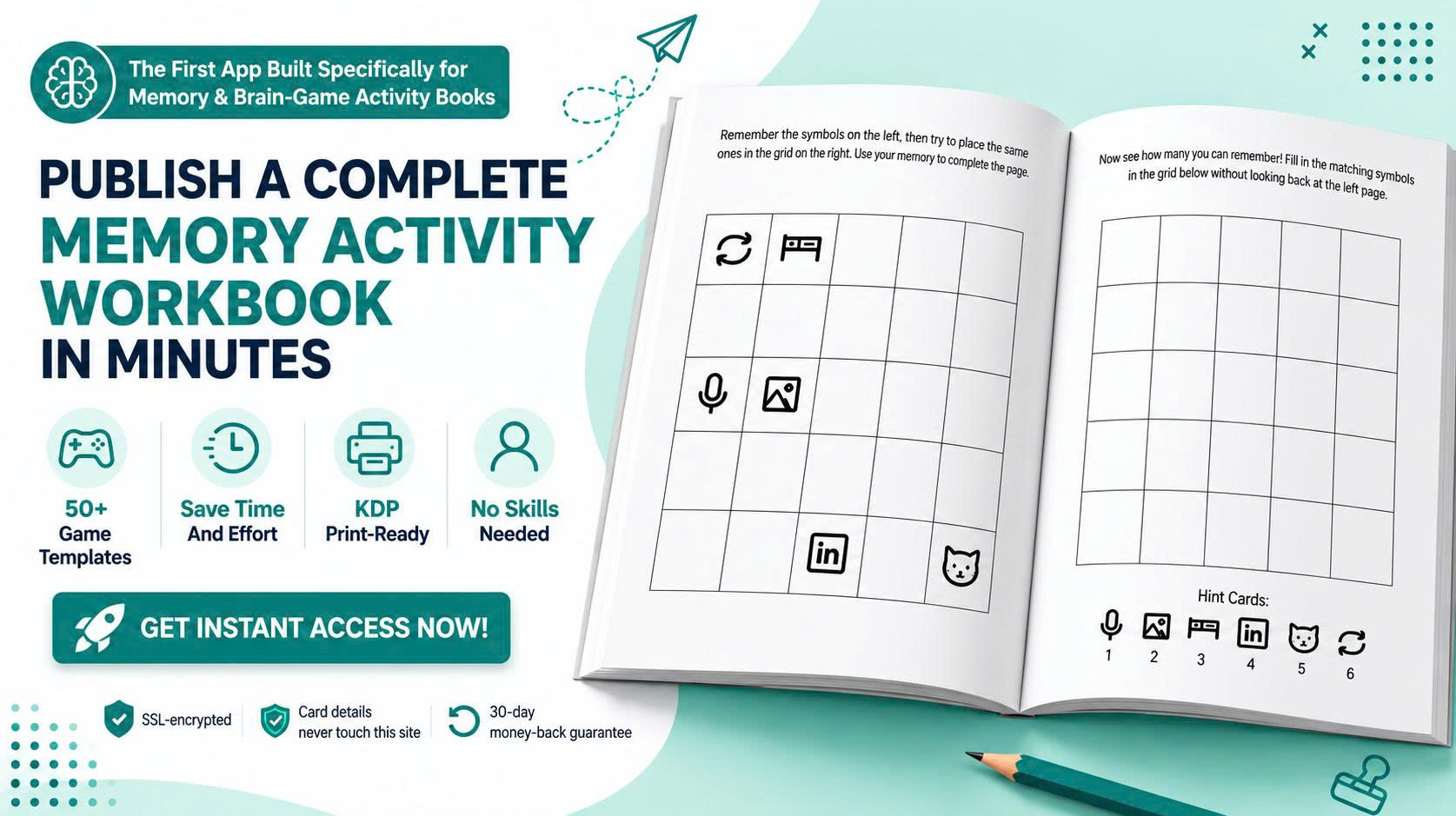
Best for: KDP publishers, printable creators and activity-book sellers who want mixed memory and brain-game interiors without manually designing every activity from scratch.
Main strength: It combines activity generation, answer-key creation, editing, multi-page book assembly and print-oriented export in one browser workflow.
Main limitation: The $19 Starter edition contains 25 templates, not the complete 50+ library, and whole-book bulk generation requires the Pro upgrade.
My conclusion: Starter is capable of producing real workbook interiors on its own. The upgrades mainly increase variety, cover capabilities and production speed.
One of the biggest misconceptions in low-content publishing is that creating an activity book simply means generating a large number of puzzles. That works reasonably well when the entire book contains one format. A 100-page Sudoku book, for example, can follow essentially the same production logic from beginning to end.
A memory and brain-game workbook is different. A strong interior may combine short-term recall, visual memory, story comprehension, face-name association, attention exercises, word activities, logic puzzles, spatial reasoning, nostalgia prompts and progress trackers.
This is where many publishing workflows become unnecessarily complicated. You generate one activity in one application, write stories in another, build answer keys somewhere else, move everything into Canva, manually resize pages and then hope the final PDF behaves correctly when uploaded.
The problem is therefore not:
“How do I create a puzzle?”
The more useful question is:
“How do I turn many different activity types into one finished, usable workbook without rebuilding the production system every time?”
The quickest way to understand why this product is different from a single-puzzle generator is to look at the interior concept itself. A memory workbook can move from symbol recall to story memory, name association, visual reasoning, pattern work and other activities without making every page feel identical.
Short workbook demonstration showing the mixed-activity approach.
Choose a template, configure the options and generate the page. The software can provide the instructions, activity layout and, where applicable, the corresponding answer key rather than leaving you with an unfinished puzzle asset.
The wider library covers Memory, Focus, Logic, Word, Spatial, Reminiscence and Trackers. This makes it possible to build a more balanced workbook instead of repeating the same exercise for dozens of pages.
Generated pages remain editable. Text, images and shapes can be repositioned, objects can be layered or grouped, and pages can be reordered inside the same environment.
The system supports KDP-standard page sizes, bleed and no-bleed options, trim guides and export to PDF, JPG and 300 DPI PNG. That keeps the workflow focused on publishing rather than merely creating screen graphics.
This is the section I would pay the most attention to because the full Memory Activity Prints ecosystem contains more than 50 templates, but the front-end Starter edition does not unlock all of them.
The Starter plan currently gives you 25 activity templates drawn from all seven categories. That is enough to create varied interiors, but it is different from receiving the full 50+ library.
| Starter Feature | What It Means |
|---|---|
| 25 game templates | A selection covering all seven activity categories, rather than 25 versions of one puzzle. |
| Page-by-page generation | Select an activity, configure it and add the finished page to your book. |
| Automatic answer keys | Supported activities generate matching solution pages. |
| Fresh AI content | Selected story, word, trivia and reminiscence activities can receive new content when generated. |
| WYSIWYG design studio | Adjust text, images, shapes, layers, positioning and page order. |
| KDP-oriented sizing | Use standard trim sizes plus bleed/no-bleed and trim-guide options. |
| PDF / JPG / 300 DPI PNG | Export a single page or the assembled workbook. |
| 100 downloads per month | Enough for moderate production, but not unlimited. |
| Commercial rights including PLR | Use the content you create commercially according to the vendor's license terms. |
For me, the important point is that the front end does not appear to be a deliberately crippled teaser. You can create complete interiors with it. The optional upgrades become more relevant when you want the entire template library, integrated covers or faster production.
The easiest way to understand the funnel is: Create → Expand → Scale → Market. You do not need every upgrade simply to build and export a workbook.
Includes 25 game templates across the seven categories, page-by-page generation, answer keys, selected AI-written content, WYSIWYG editing, KDP-oriented export and commercial rights.
Best for: users testing the niche or producing books at a moderate pace.
Adds the complete 50+ template library, Book Cover Editor, KDP-compliant cover templates, unlimited credit-free AI image generation, 1,700+ icons, Grid Mode and a higher monthly download limit.
My view: Standard is probably the most practical upgrade for someone who plans to create this type of workbook regularly.
The major difference here is Bulk Generation Mode, which can create an entire book interior in one pass. Pro also adds unlimited monthly downloads, up to 200 puzzles per book, additional drawing tools, extra graphic assets and PPT/SVG export.
Best for: volume publishers and anyone building multiple related books or series.
This upgrade moves away from page production and into publishing support. It includes the KDP Listing Launchpad, Category Finder, a 30-Day Playbook and a Keyword Research Vault with 570 keywords.
If you already have a keyword, listing and category workflow, this is likely the easiest upgrade to skip.
Memory Activity Prints helps you create the workbook pages. My separate buyer package is designed to support the broader publishing workflow around the software, including digital publishing, creator workflows, content development, marketing resources and supporting digital-business activities.
ONE PURCHASE → ONE COMPLETE RESOURCE LIBRARY
Rather than listing a long series of individual bonus titles, qualifying buyers receive access to the complete related-resource package connected to this promotion.
Memory and brain-game books can be positioned around enjoyment, mental engagement, nostalgia, focus, recreational challenge and structured activity.
What publishers should avoid is turning an activity workbook into an unsupported medical promise.
Memory Activity Prints creates general recreational and educational activity worksheets. The pages are not medical devices and should not be promoted as diagnosing, treating, curing or preventing a medical condition.
This matters especially when selling to audiences that include older adults, caregivers or senior-living activity programs. Clear, responsible positioning creates a more credible product than exaggerated brain-health claims.
At the time of this review, Memory Activity Prints Starter is being offered at $19 as a one-time payment. Because this is promotional pricing, the current price should always be confirmed on the official checkout page.
The vendor advertises a 30-day money-back guarantee, which gives buyers an opportunity to access the software, test the workflow and decide whether it fits their publishing process.
Remember that the guarantee applies to the vendor's product purchase. My $119K related-resource bonus package is a separate affiliate incentive offered to qualifying buyers through this page.
Memory Activity Prints becomes more interesting when you stop evaluating it as another puzzle generator and instead evaluate it as a production system for mixed-activity workbooks.
Generating a maze or a Sudoku is not particularly difficult anymore. The heavier work begins when a publisher wants several activity formats, different difficulty levels, study-and-recall pairs, answer keys, consistent page design and print-ready output inside the same book.
That is the gap this software is attempting to close.
I also like that the funnel is reasonably easy to understand. Starter provides the core interior-building workflow. Standard opens the complete library and integrated cover features. Pro focuses on speed and higher-volume production. The Promotional Material Pack moves into listing and marketing support.
There are still responsibilities the software cannot remove. Publishers should inspect every book, check factual AI content, evaluate readability, test answer keys and make their own decisions about niches, covers, keywords, metadata and promotion.
That is also why my affiliate bonus is positioned as a broader related-resource library rather than a short list of individual add-ons.
The software creates the workbook pages.
The $119K buyer package gives qualifying customers access to a broader collection of
publishing, creator, KDP, template, tool and supporting digital resources.
For a publisher who has looked at memory and brain-game workbooks and thought that coordinating all the different page types would take too much time, Memory Activity Prints offers a practical way to reduce that production barrier.